
에도 기리코, 색을 깎아 드러낸 투명함
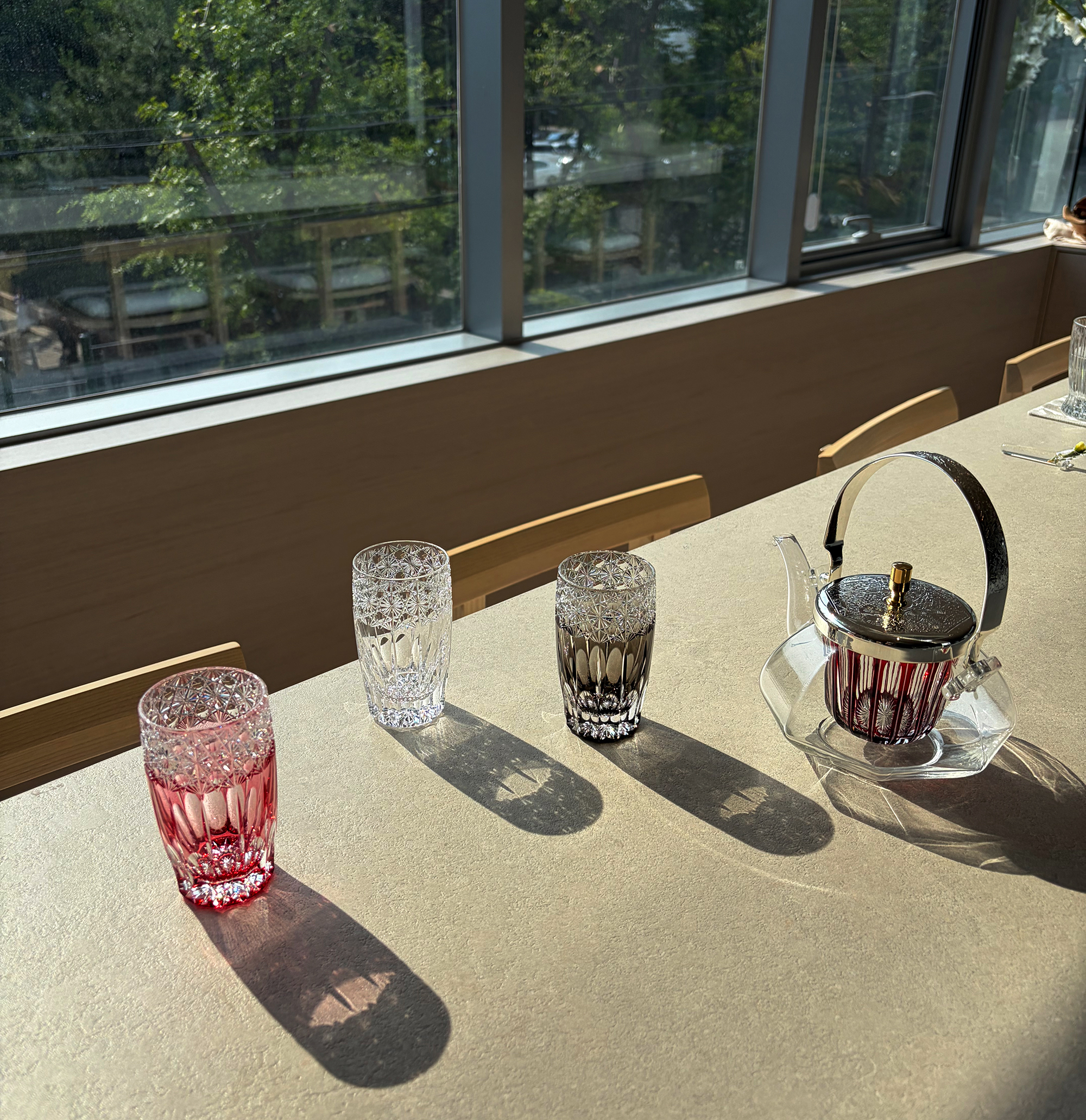
처음 보면 색이 있는 유리잔처럼 보입니다.
하지만 에도 기리코의 색은 유리 자체의 색이 아닙니다.
투명한 유리 위에 아주 얇은 색유리를 한 겹 입힌 뒤, 그 위를 다시 깎아 만들어집니다.
장인은 회전하는 칼로 무늬를 하나씩 갈아냅니다.
그러면 색유리는 벗겨지고, 그 아래 숨어 있던 투명한 유리가 모습을 드러냅니다.
그래서 기리코의 무늬는 무언가를 더한 흔적이 아니라,
색을 걷어낸 흔적입니다.
빛이 닿으면 그 차이는 더욱 선명해집니다.
색이 남아 있는 부분은 깊이를 만들고,
걷어낸 투명한 부분은 빛을 통과시키며 그림자를 새깁니다.
잔 아래에 드리운 그림자까지 무늬를 품는 이유도 그 때문입니다.
전부 갈아내면 투명한 유리만 남고,
전혀 갈아내지 않으면 그저 색이 있는 잔이 됩니다.
에도 기리코의 아름다움은
남겨둔 색과 걷어낸 투명함이 함께 있을 때 비로소 완성됩니다.
더하는 것이 아니라,
덜어내는 일.
그 절제가 만들어낸 투명함이,
오늘도 잔 안의 술과 빛을 가장 아름답게 비춰줍니다.
하쿠시에서 이 잔은 사케 페어링에 사용됩니다.
같은 술이라도 어떤 잔에 담기느냐에 따라
술빛은 달라지고, 손에 닿는 감각도 달라집니다.
그래서 술의 향과 질감, 계절의 분위기에 맞춰
여러 색의 기리코 가운데 그날의 잔을 고릅니다.
그날의 술은, 그날의 기리코에서 완성됩니다.
Edo Kiriko, Revealing Transparency by Cutting Away Color
At first glance, Edo Kiriko appears to be simply colored glass.
But its color does not come from the glass itself.
A thin layer of colored glass is carefully fused over clear glass, and then cut away by hand.
Using a rotating cutting wheel, the artisan carves each pattern one by one.
Where the wheel passes, the colored layer is removed, revealing the clear glass beneath.
In other words, the patterns of Edo Kiriko are not something added.
They are the traces of color that has been taken away.
When light falls on the glass, the contrast becomes even more striking.
The remaining color creates depth,
while the exposed clear glass allows light to pass through, casting intricate shadows.
That is why even the shadows beneath the glass carry the pattern.
If all the color is removed, only clear glass remains.
If none is removed, it is simply a colored glass.
The beauty of Edo Kiriko exists only where color and transparency coexist.
It is not about adding,
but about taking away.
The transparency created through this restraint allows the light—and the sake within—to reveal themselves most beautifully.
At 𝗛𝗔𝗞𝗨𝗦𝗜, these glasses are used for our sake pairing.
The same sake can feel entirely different depending on the glass it is served in.
Its appearance changes, as does the sensation of holding it.
For that reason, we select the color of each Kiriko glass according to the aroma, texture, and seasonal character of the sake being served.
Each sake finds its completion in the Kiriko chosen for that day.