
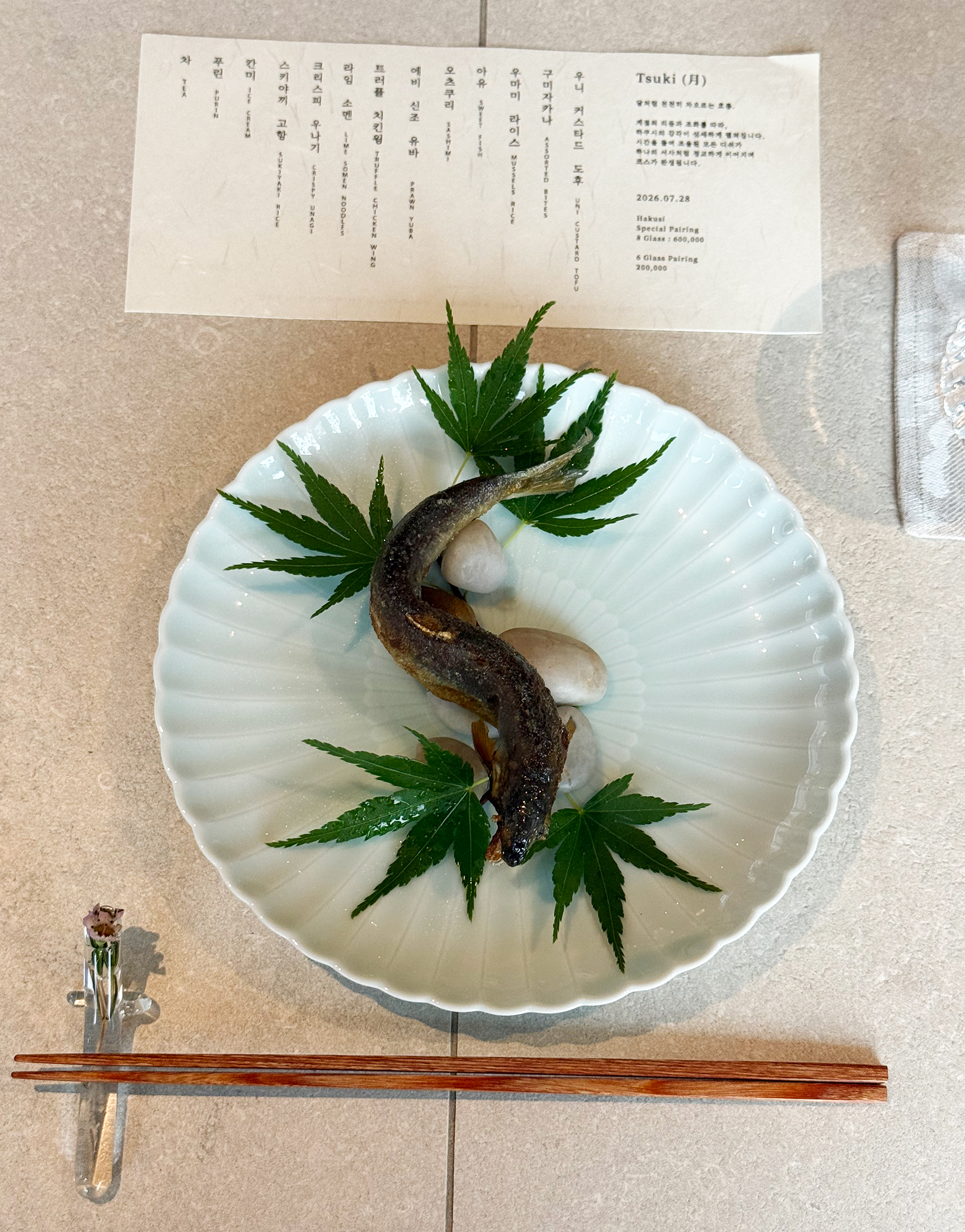
아유가 오는 계절
아유는 한 해를 다 살지 못하는 물고기입니다.
가을에 태어나 바다에서 겨울을 나고, 봄이 되면 맑은 강을 거슬러 올라옵니다.
여름 내내 강의 돌에 붙은 이끼를 먹으며 몸을 키우고, 가을이 오면 다시 하류로 내려가 알을 낳고 생을 마칩니다.
그 짧은 생애 중에서도, 우리가 아유를 맛볼 수 있는 시간은 여름의 몇 주에 불과합니다.
아유는 일본에서 향어(香魚)라고도 불립니다.
이끼를 먹고 자라기 때문에, 살에서는 수박이나 오이를 닮은 은은한 향이 납니다.
그래서 아유의 향에는 그해 강의 풍경이 그대로 담겨 있습니다.
이 물고기를 대하는 방식은 오래전부터 정해져 있었습니다.
내장을 빼지 않은 채 꼬치에 꿰어, 숯불 위에서 천천히 굽습니다.
소금만 더해 아유 본연의 향과 감칠맛을 살립니다.
겉은 바삭하게, 속은 은은한 쓴맛과 단맛이 함께 남도록 굽습니다.
머리부터 꼬리까지, 뼈째 씹어 먹는 것이 아유를 가장 온전히 맛보는 전통적인 방식입니다.
하쿠시에서도 아유는 이 전통적인 방식 그대로 올립니다.
꼬치에 꿴 채 숯불 위에서 한 시간 가까이 천천히 굽고,
그 시간 동안 마치 강을 헤엄치는 듯한 곡선을 손으로 조금씩 잡아갑니다.
손님 앞에는 그렇게 한 마리의 아유가 그대로 놓입니다.
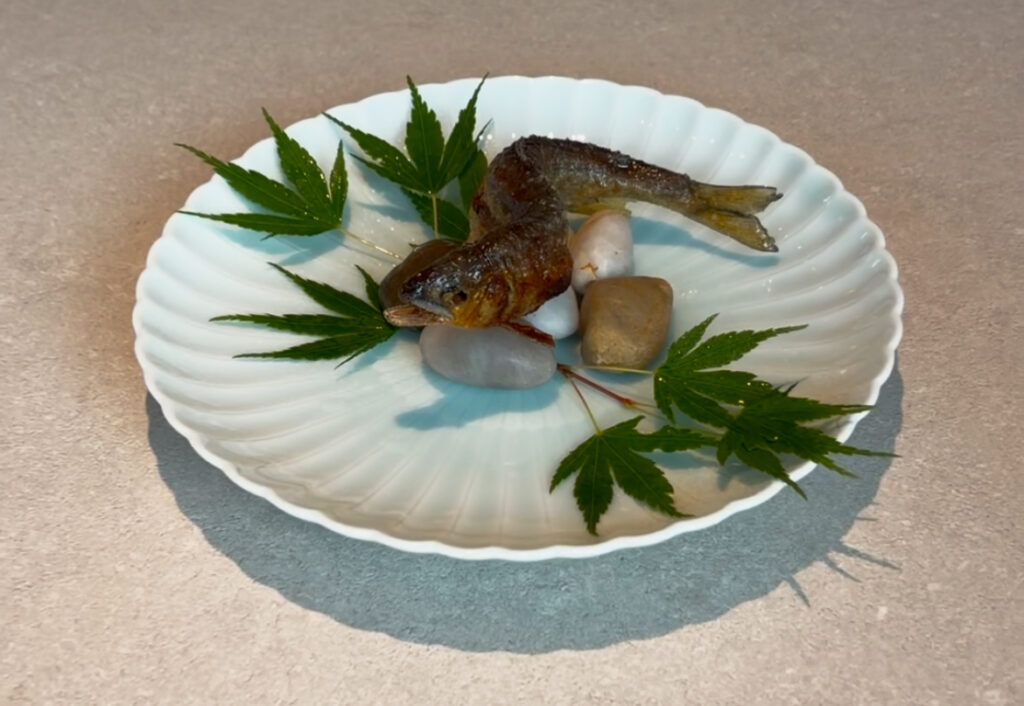
일본 요리에는 계절을 대하는 세 가지 감각이 있습니다.
하시리(走り), 계절보다 한 발 먼저 도착하는 식재료.
슌(旬), 가장 충만한 제철의 순간.
그리고 나고리(名残), 사라져가는 계절을 아쉬워하는 마음.
아유는 이 세 감각을 모두 품은 재료입니다.
초여름에는 하시리로, 한여름에는 슌으로, 여름의 끝자락에는 나고리로 다가옵니다.
여름이 지나면 아유는 다시 강을 떠나고, 식탁에서도 사라집니다.
그리고 다음 여름이 올 때까지, 그 맛은 기다림으로 남습니다.
Ayu lives for less than a year.
Born in autumn, it spends the winter at sea before returning to clear rivers in spring.
Throughout the summer, it feeds on the algae growing on river stones, slowly maturing before swimming downstream again in autumn to spawn and complete its life cycle.
Within that brief life, the time we can enjoy ayu lasts only a few weeks each summer.
In Japan, ayu is also known as kōgyo (香魚), the “fragrant fish.”
Because it feeds on river algae, its flesh carries a delicate aroma often compared to watermelon or cucumber.
Its fragrance is said to reflect the river itself, capturing the landscape of that particular season.
For generations, there has been only one way to prepare ayu.
It is skewered whole, without removing the innards, and slowly grilled over charcoal.
Seasoned only with salt, the fish is cooked until the skin becomes crisp while the flesh retains its gentle bitterness and subtle sweetness.
It is traditionally eaten whole—from head to tail, bones and all.
Nothing is removed or separated; the fish is accepted exactly as it is.
At 𝗛𝗔𝗞𝗨𝗦𝗜, we follow this tradition.
Each ayu is grilled over charcoal for nearly an hour.
During that time, its body is carefully shaped by hand to resemble the gentle curve of a fish swimming upstream.
It is then served whole, just as it comes off the fire.
Japanese cuisine embraces three ways of experiencing the seasons.
Hashiri (走り) — the first arrival of the season.
Shun (旬) — the moment when an ingredient reaches its peak.
Nagori (名残) — the lingering farewell to a season as it comes to an end.
Ayu embodies all three.
In early summer, it is Hashiri.
At the height of summer, it becomes Shun.
As summer fades, it turns into Nagori.
When summer ends, ayu disappears from both the river and the table.
Until the following summer arrives, its flavor remains only in memory—and in the anticipation of meeting it again.